When you buy through links on our articles, Future and its syndication partners may earn a commission.

Artemis 2's historic, action-packed lunar flyby is in the books.
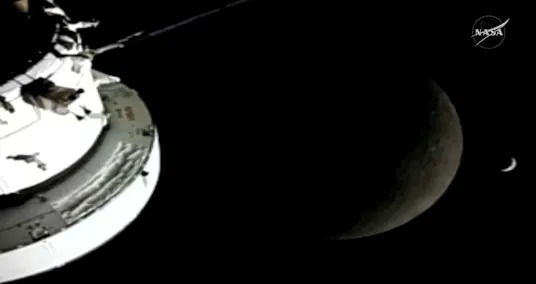
Artemis 2 looped around the moon's far side today (April 6), in a nearly seven-hour encounter that gave its four astronauts views of Earth's nearest neighbor that human eyes had never seen before.
The Artemis 2 crewmembers also observed a total solar eclipse from beyond the moon and set a big spaceflight record, traveling farther from their home planet than anyone ever had before.
A new distance record for humanity

Artemis 2 is the first mission to send astronauts beyond low Earth orbit (LEO) since Apollo 17 did so way back in 1972. The current flight launched on April 1, sending NASA's Reid Wiseman, Victor Glover and Christina Koch and the Canadian Space Agency's Jeremy Hansen aloft on board an Orion capsule that the astronauts named "Integrity."
Integrity arrived in lunar space early this morning. The capsule journeyed into the moon's "sphere of influence," the region where lunar gravity is stronger than that of Earth, at 12:37 a.m. EDT (0437 GMT).
About 13.5 hours later, the four Artemis 2 astronauts crossed another threshold, getting more than 248,655 miles (400,171 kilometers) from Earth. That was our species' old distance record, set in April 1970 by the three astronauts of NASA's Apollo 13 mission.
And Integrity continued cruising outward for about five more hours, reaching a maximum distance from Earth of about 252,756 miles (406,771 km) just after 7:00 p.m. EDT (2300 GMT) — a mark the Artemis 2 crew hopes gets broken soon.
"We, most importantly, choose this moment to challenge this generation and the next to make sure this record is not long-lived," Hansen said shortly after Artemis 2 surpassed Apollo 13.
There were some touching moments as well. As the flyby began, the crew asked to name an unnamed moon crater they observed after their ship Integrity.
Another crater, they proposed, should be named Carroll in honor of Carroll Taylor Wiseman, wife of Artemis 2 commander Reid Wiseman, who tragically died in 2020 from cancer.
"Integrity and Carroll Crater, loud and clear," Mission Control replied.
Eyes on the moon — for science
But all of this action was just a warmup for the mission's main event — the flyby.
The encounter officially began at 2:45 p.m. EDT (1845 GMT), when Integrity was about 10,700 miles (17,220 km) from the lunar surface. And it was not a sightseeing cruise for the Artemis 2 astronauts; they studied the moon's surface for hours, following a detailed checklist drawn up by the mission science team.
After all, the flyby was a rare research opportunity. People hadn't viewed the moon up close in more than 50 years, and Artemis 2's unique "free return" trajectory — in which it looped around the moon without entering lunar orbit — afforded unprecedented views of the gray, cratered surface.
What's more, the human eye is very good at picking up subtle variations in color and texture — better than robotic spacecraft cameras, in fact. So, the Artemis 2 crew could conceivably detect details that help scientists better understand lunar geology and evolution, and help planners map out future crewed missions to the moon's surface.

One of the astronauts' key observation targets was the Orientale Basin, a 600-mile-wide (965 km) impact crater known as the "Grand Canyon of the moon." It straddles the line between the moon's near and far sides and, until Artemis 2, had never been seen in sunlight by human eyes, according to NASA.
The astronauts were therefore assiduous in their descriptions of the crater. Take, for example, Wiseman's words on one of Orientale's prominent features.
"The annular ring, which I think everybody kind of describes as like a pair of lips or a kiss on the far side of the moon, from here is very circular in nature," Wiseman, the Artemis 2 commander, told Mission Control.
"The northern part of it is wider, darker; the southern part is much lighter," he added. "It is very neat-looking — far more circular than I remember it looking in our training."
Artemis 2 complemented such naked-eye observations with photographic evidence, captured by an array of 32 cameras. Fifteen of those are mounted to Integrity; the other 17 are handheld instruments operated by the astronauts.
Those astronauts aren't robots, of course, so they have emotional reactions to what they see out of Integrity's windows. And Koch shared a bit of what she was feeling during the flyby with Mission Control.
"It was an incredible experience. At one point towards the end of the images of my time in Window 3, I just had an overwhelming sense of being moved by looking at the moon," Koch said.
"It lasted just a second or two, and I actually couldn't even make it happen again, but something just drew me in suddenly to the lunar landscape, and it became real," she added. "And the truth is, the moon really is its own body in the universe."
At 6:44 p.m. EDT (2244 GMT), Integrity lost contact with Mission Control as it disappeared behind the moon from Earth's perspective. This blackout, or loss of signal (LOS), was completely expected, so it wasn't exactly nerve-wracking.
"We've handed over between Deep Space Network sites the whole mission," Artemis 2 Flight Director Rick Henfling said before the blackout. "This is just like an extended handover. We know where the spacecraft is, we know where it'll be when we come out of LOS, and so we're not worried."
Integrity reestablished contact right on schedule, at 7:24 p.m. EDT (2324 GMT). But some important stuff happened during the 40-minute blackout.
For example, the high point of the flyby — or the low point, in orbital-dynamics terms — came at about 7:00 p.m. EDT (2300 GMT) when Integrity made its closest approach, skimming a mere 4,067 miles (6,545 km) above the lunar surface. From this distance, the moon looked about as big as a basketball held at arm's length, NASA officials said during the Artemis 2 livestream.
Two minutes later, Artemis reached its farthest point from Earth, which is now the distance record for future astronauts to chase.

A solar eclipse, too
About six hours into the flyby, the Artemis 2 crew turned their attention to a different celestial spectacle — a total solar eclipse, which began at 8:35 p.m. EDT (0035 GMT on April 7).
It was a very different sight from the eclipses we're used to here on Earth. Because the moon loomed so large through Integrity's windows, the sun was hidden behind it for much longer — about 53 minutes, compared to a maximum of about 7.5 minutes for any total solar eclipse seen from our planet. (To be clear: This eclipse was visible only to the Artemis 2 astronauts. The moon and sun were not lined up for viewers on Earth.)
Eclipses allow scientists to study the sun's wispy outer atmosphere, known as the corona, which is usually swamped by our star's immense brightness. So, the mission team gave the Artemis 2 crew some instructions.
"We've included prompts for them to describe the features that they can see in the solar corona, which can ultimately help solar scientists understand these processes in general, especially given the unique vantage point that the crew are going to have relative to our orbiting spacecraft here on Earth and our observers, our scientists, here on Earth as well," Kelsey Young, NASA's Artemis science flight operations lead, said during a press conference on Saturday (April 4).
The sun was still dangerous for the Artemis 2 crew to look at; Integrity's windows did not provide the required eye protection. They therefore donned eclipse glasses to watch the event, just as we do here on Earth.
"This is continues to be unreal," Glover said during the eclipse. "The sun has gone behind the moon, and the corona is still visible, and it's bright and it creates a halo almost around the entire moon."

"The Earth is so bright out there, and the moon is just hanging in front of us, this black orb out in front of us," he added. "Wow! It's amazing."
Wiseman concurred.
"That was an absolutely spectacular and magnificent experience," Wiseman said.
The astronauts also reported seeing at least five impact flashes on the moon's darkened surfance, evidence of meteorid impacts on the lunar surface. They also had chances to see Mercury, Mars, Venus and Saturn from beyond the moon, NASA said.
Coming home
The flyby ended tonight at around 9:20 p.m. EDT (0120 GMT on April 7). With that milestone, Artemis 2 entered a new phase: the journey back to Earth.
"I can't say enough how much science we've already learned, and how much inspiration you've provided to our entire team, the lunar science community and the entire world with what you were able to bring today," Young radioed to the Artemis 2 crew after the flyby. "You really brought the moon closer for us today, and we cannot say thank you enough."
Wiseman thanked the science team for all their training that made the crew's observations possible.
"You all knocked it out of the park," Wiseman. "Thank you for giving us this opportunity."
The flyby slingshot Integrity and its occupants back toward Earth, without the need for any major engine burns. The capsule will arrive on Friday evening (April 10), coming home with a parachute-aided splashdown off the coast of San Diego.
That will mark the end of the Artemis 2 mission but the start of a new chapter — the buildup to Artemis 3. That crewed mission, targeted to launch in 2027, will test rendezvous and docking in Earth orbit. If all goes well, NASA will put boots down near the moon's south pole on Artemis 4 in late 2028. And the agency will start building a base there over the next few years.
Editor's note: Space.com Editor-in-Chief Tariq Malik and Spaceflight Writer Josh Dinner contributed to this report from NASA's Johnson Space Center, home of Artemis 2 Mission Control, in Houston.
LATEST POSTS
- 1
 NASA to bring astronauts home from space station early due to a medical issue
 - 2Charlotte faith leaders hold interfaith forum on Black and Palestinian solidarity
- 3German economic institutes cut forecast in half over Iran war
- 4Comet C/2025 K1 (ATLAS) breaks apart in incredible telescope photos
- 5EPA watchdog finds nation’s most contaminated sites are vulnerable to flooding, wildfires




- CDC advisory panel delays vote on hepatitis B vaccines after unruly meeting
- My Pioneering Excursion: Building a Startup
- Astronomers detect rare 'free floating' exoplanet 10,000 light-years from Earth
- From candy cane fishing to ornament switcharoo, here are some of the best games you can play with your loved ones this holiday season
- Two Endangered Bengal Tiger Cubs Die Days Apart at Zoo After Contracting Virus
- Exploring the Difficulties of Beginning a Family: Individual Experiences
- Iranian-backed militias escalate in Iraq, targeting Kurdistan Region president Nechirvan Barzani
- Aspect Biosystems receives funding for cellular medicine project
- Genesis Marks 10th Anniversary With Magma GT Concept Aimed at High-Performance Flagships